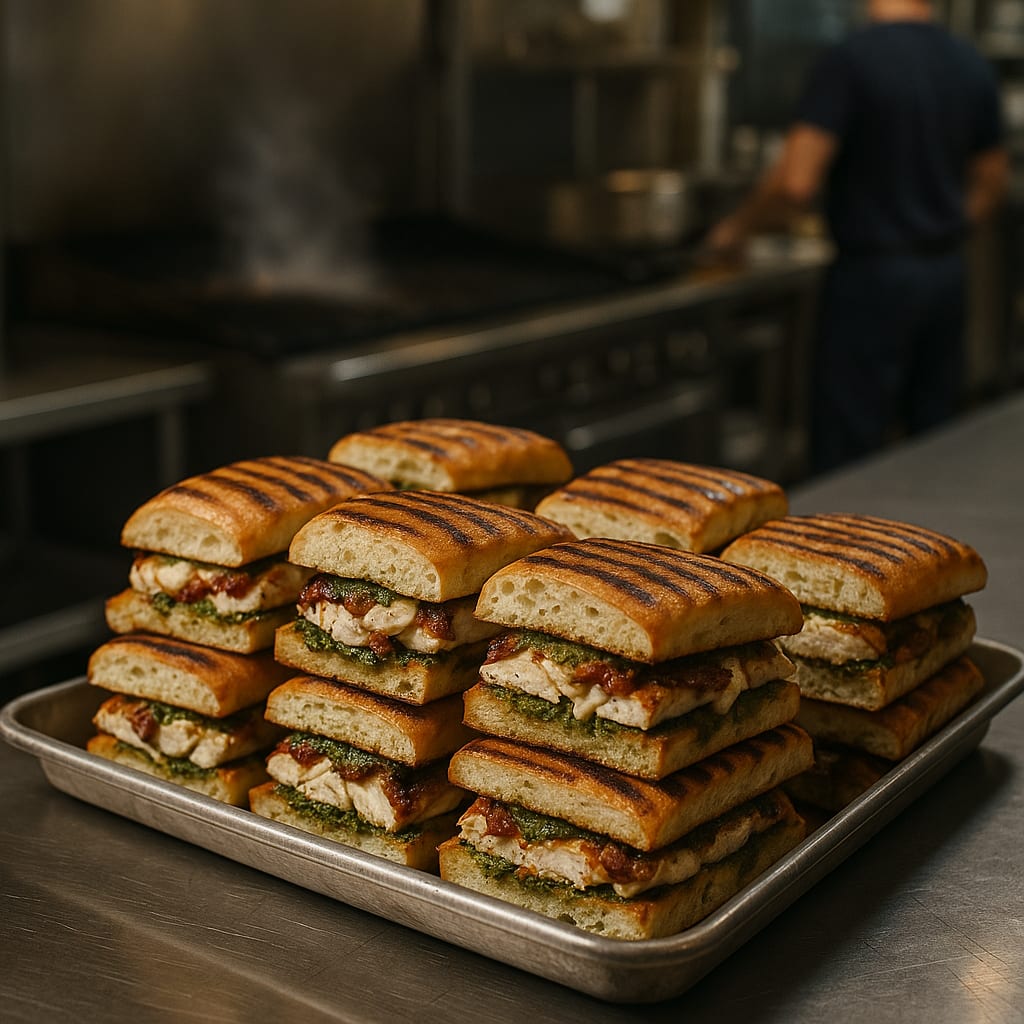
Sun-Dried Tomato Pesto Panini Press
Grilled chicken, sun-dried tomato pesto, and pressed focaccia for the crew
Pesto panini night—grilled chicken, pressed focaccia, crackling crust for the crew
Why crews like it: A crackling pressed crust, real grilled chicken instead of deli meat, and pesto that soaks into the focaccia — sandwich night that actually smells like the grill.
952Cal
98gProtein
37gCarbs
44gFat
Ingredients
- 4.4 Lb Chicken Breast
- 1 1/4 Cups Sun-Dried Tomato Pesto
- 4 whole Focaccia Loaves
- 1 1/4 Lb Buffalo Mozzarella
- 3/4 Cup Oil-Packed Sun-Dried Tomatoes
- 1/4 Cup Grapeseed Oil
- 3 Tbsp White Balsamic Vinegar
- 2 whole Shallots
- 4 Garlic Cloves
- 3 Cups Peppered Arugula
- 1/4 Cup Clarified Butter
Instructions
- Pound and marinate the chicken: Pound the chicken breasts between plastic wrap to an even 3/4 inch — the thin tail of an unpounded breast dries out long before the thick end is safe. Whisk the grapeseed oil, white balsamic vinegar, minced shallots, garlic, and a tablespoon of salt, then toss with the chicken. Refrigerate 1–2 hours; past 4, the vinegar starts turning the surface mealy.
- Press the mozzarella dry: Slice the buffalo mozzarella 1/4 inch thick and press it between paper towels with a sheet pan on top while you work — buffalo mozzarella carries a lot of whey, and one wet slice steams the crust soggy from the inside. Slice the drained sun-dried tomatoes into ribbons and wash and dry the peppered arugula.
- Grill the chicken to 165°F: Grill the breasts over medium-high, about 450°F at the grate, 5–6 minutes per side, and leave them alone until they release — tearing them off early rips the crust away. They're finished at 165°F on an instant-read at the thickest point, with deep golden bar marks and clear juices. Crowding the grate drops the heat and trades char for steam.
- Rest, then slice on the bias: Rest the chicken 5 minutes on a cutting board so the juices redistribute instead of flooding the bread, then slice 1/2 inch thick on the bias. Bias slices lie flat and stack without sliding — thick chunks punch through the top of the sandwich under the weight of the press.
- Split and paint the focaccia: Split each focaccia loaf horizontally and cut into sandwich squares — two per loaf, eight total. Spoon the sun-dried tomato pesto onto both cut faces and take it edge to edge; a dry rim is the first thing a tired crew notices. Go heavier than looks reasonable — the press mutes it.
- Build every sandwich before the press: Layer each sandwich: mozzarella on the bottom face, sliced chicken, sun-dried tomato ribbons, more mozzarella, then the top. Cheese on both faces glues the sandwich shut as it melts. Add the peppered arugula now if the crew likes it wilted and mellow; hold it for after the press if they want pepper and crunch.
- Heat the flat-top, butter the outsides: Preheat the flat-top or two heavy pans to 375°F — a water drop should skitter and dance, not vanish instantly. Brush the outside faces of every sandwich with clarified butter; whole butter's milk solids scorch black at pressing temperatures, while clarified goes deep, even gold.
- Press until the crust crackles: Press the sandwiches 3–4 minutes per side under a panini weight or a heavy sheet pan with cans stacked on top. You want a deep golden, crackling crust with cheese just creeping out the seams. The chicken inside already hit 165°F, so the press has one job: crisp and melt. If the surface races past golden toward black, drop it to 350°F.
- Hold for call interruptions: If tones drop mid-cook: turn off direct heat and cover grilled chicken and panini — hold at 140°F in a warm cabinet or 200°F oven, never below 140°F for more than 30 minutes cumulative. Log hold time on the pan with a grease pencil. If tones drop after service, cover hot food and keep sides on low heat or ice as appropriate. On return, spot-check proteins at safe internal temp before reopening the line.
- Pack down leftovers safely: Cool grilled chicken and hot components in shallow hotel pans within two hours — deep pots stay in the danger zone too long. Label with date; reheat proteins to 165°F minimum before second shift. Store cold components separately so textures survive overnight.
Tonight's spread
- Main: Pressed chicken and sun-dried tomato pesto panini
- Sides: tomato soup cups, kettle chips
- Condiments: extra pesto, red pepper flakes
- Set hot components closest to the crew; cold crunch and toppings at the far end of the line.
- Keep a backup tray at 200°F for firefighters returning from a run.
Hall tips
- Pound to an even 3/4 inch every time — uniform thickness does more for juicy chicken than any marinade.
- Press the buffalo mozzarella dry or skip it — wet cheese turns the middle of the sandwich to soup.
- Re-crisp held panini 2 minutes per side on a dry flat-top; foil-wrapped holding softens the crust.
- Keep a backup tray at 200°F for firefighters returning from a run — never serve picked-over pans to late crew.
- Taste for salt at the end — hall palates run salty after long shifts.
- Log hold times on the pan with a grease pencil when tones drop mid-service.
- Spot-check proteins with an instant-read thermometer before reopening the line after a call.
Substitutions
- Low-moisture provolone or fresh mozzarella swaps for buffalo mozzarella and is far more forgiving on moisture.
- Basil pesto works 1:1 if sun-dried tomato pesto is out — brighter and less sweet.
- Ciabatta stands in for focaccia; it presses thinner and crispier.
- No clarified butter? Olive oil browns clean at 375°F, or make your own by melting butter and skimming the foam.
Meal prep
Marinate the chicken up to 4 hours ahead and grill to 165°F before the crew sits down. Hold sliced chicken covered at 140°F or above up to 30 minutes. Press sandwiches in batches at 375°F, 3–4 minutes per side.
Leftovers
- Cool grilled chicken in shallow pans within two hours; label with date and reheat to 165°F before second shift.
- Store cold sides separately — hot and cold stacked overnight ruins texture.
- Re-crisp day-two panini 4–5 minutes per side on a dry 350°F flat-top — the microwave turns them to sponges.
- Extra sliced chicken becomes pesto pasta or a chopped salad next shift.
- Gas or charcoal grill
- Flat-top griddle or two heavy cast-iron pans
- Panini weight or heavy sheet pan
- Meat mallet
- Instant-read thermometer
- Cutting board
- Tongs
Related recipes
- Honey Chipotle Grilled Chicken Thighs
- Smoked Chicken Quarters with White Sauce
- Brisket-Style Beef Sandwiches